How Balanced Recognition Can Strengthen Confidence, Responsibility and Aspiration
“Recognition is not merely about rewarding success. It is about shaping what future generations choose to become.”
Introduction
Walk into almost any school after examination results are announced, and one thing immediately becomes clear.
The highest scorers become the face of success.
Their photographs appear on school notice boards.
Their names are celebrated on websites and social media.
Parents proudly share their achievements.
Teachers applaud their dedication.
And rightly so.
Academic excellence deserves recognition.
Yet an important question often remains unanswered.
What about the student who transformed the student council?
What about the girl who organised community service activities?
The boy who mentored weaker classmates?
The student who represented the school with integrity at every competition?
The young innovator who designed a science project that solved a real problem?
The quiet volunteer who consistently demonstrated kindness, discipline and responsibility?
These achievements also deserve recognition.
Because schools do not exist merely to produce high examination scores.
They exist to develop capable, ethical and responsible human beings.
Recognition Shapes School Culture
Recognition is one of the most powerful educational tools available to schools.
Students naturally notice what adults celebrate.
If only examination marks receive recognition,
Students gradually come to believe that marks alone define success.
When schools celebrate
- leadership,
- creativity,
- innovation,
- teamwork,
- discipline,
- service,
- responsibility,
Students begin to aspire to those qualities as well.
Recognition silently teaches values.
Achievement Has Many Dimensions
Every child possesses different strengths.
Some excel academically.
Some lead naturally.
Some communicate exceptionally well.
Others demonstrate compassion.
Some solve problems creatively.
Some quietly help everyone around them.
Education becomes richer when schools recognise multiple dimensions of achievement.
Balanced recognition acknowledges that excellence can appear in many forms.
Confidence Grows Through Recognition
Recognition has profound psychological value.
A certificate cannot transform a child overnight.
But genuine appreciation often changes how students see themselves.
When students feel valued,
they become more confident.
Confident students participate more.
They communicate better.
They take greater responsibility.
They become willing to attempt larger challenges.
Recognition therefore strengthens aspiration.
Recognition Encourages Responsibility
Leadership recognition is especially powerful.
When students receive responsibility,
they usually begin behaving more responsibly.
House captains.
Prefects.
Club leaders.
Student council members.
Environmental ambassadors.
Library volunteers.
Sports captains.
These positions are not simply titles.
They become opportunities to practice leadership.
Recognition encourages students to grow into the responsibilities they receive.
Character Deserves Public Recognition
Character is often discussed but rarely recognised publicly.
Yet schools witness acts of character every day.
Students returning lost belongings.
Helping classmates without being asked.
Respecting school rules.
Demonstrating honesty during examinations.
Supporting younger students.
Serving during school events.
Standing against bullying.
Showing compassion.
Such actions deserve equal visibility.
When schools recognise integrity,
they communicate an important message:
Character matters.
Innovation Should Become Visible
The future belongs to innovators.
Schools should celebrate
student researchers,
young entrepreneurs,
science innovators,
creative writers,
artists,
technology creators,
problem-solvers.
Recognition encourages curiosity.
Curiosity creates innovation.
Innovation shapes tomorrow.
Every Child Should Have an Opportunity to Shine
Balanced recognition is not about distributing certificates to everyone.
It is about ensuring that every student has an opportunity to pursue excellence in meaningful ways.
Some students will achieve academically.
Others through leadership.
Others through sports.
Music.
Art.
Innovation.
Community service.
Environmental action.
Debate.
Communication.
Research.
Schools become healthier communities when every student sees a pathway to success.
Recognition Inspires Future Students
Recognition extends beyond today’s recipients.
A younger student watching an award ceremony begins imagining future possibilities.
“I want to stand there one day.”
That simple thought creates aspiration.
Recognition therefore inspires not only recipients,
but entire school communities.
Recognition Strengthens Parent Engagement
Parents naturally value academic achievement.
However,
Balanced recognition also helps families appreciate qualities often overlooked.
When schools publicly celebrate
leadership,
service,
discipline,
innovation,
Parents begin encouraging these qualities at home as well.
Schools and families gradually move toward a shared understanding of success.
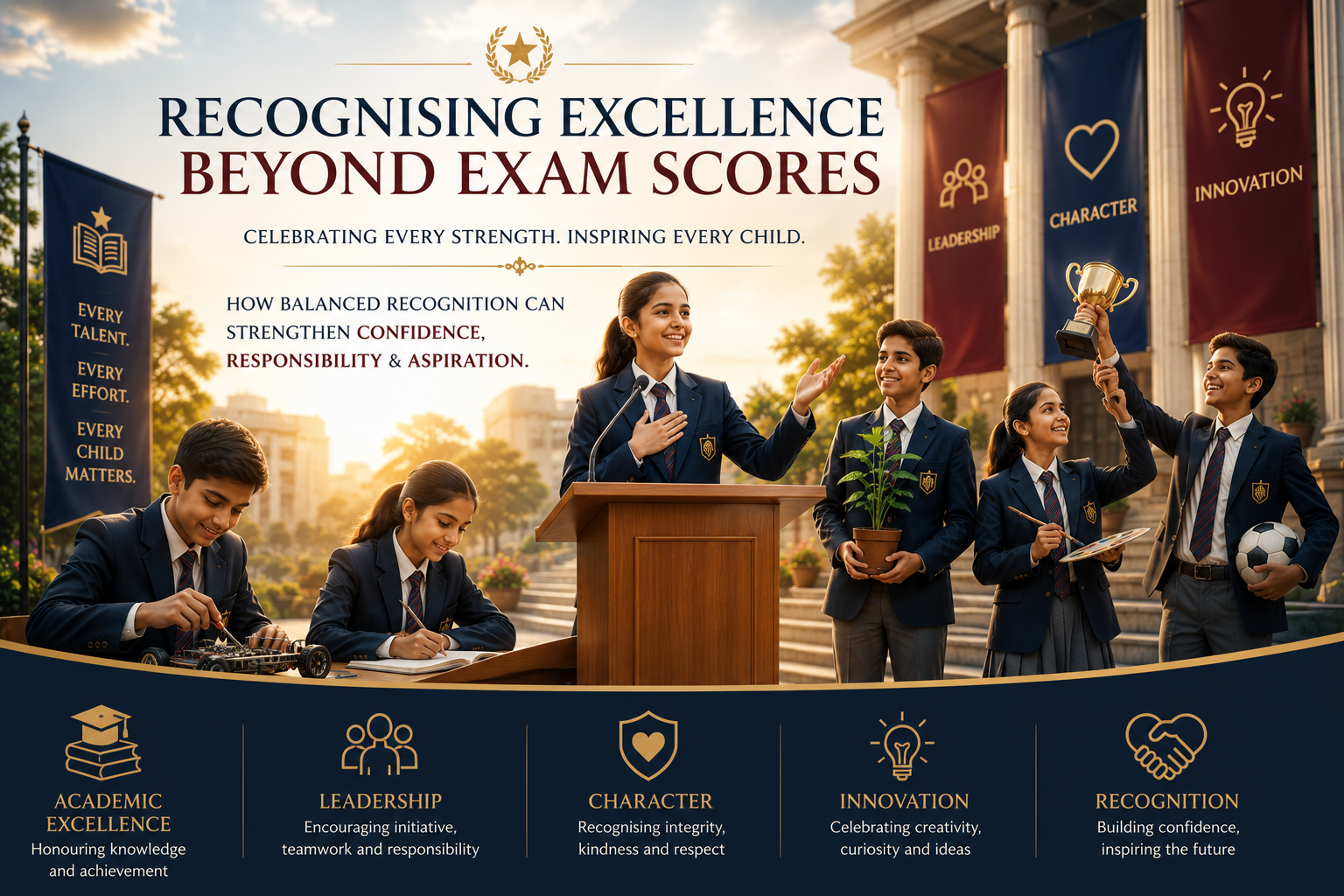
The Four Pillars of Balanced Recognition
Academic Excellence
Celebrating scholarship and intellectual achievement.
Leadership
Recognising initiative, responsibility and teamwork.
Character
Honouring integrity, empathy and ethical conduct.
Innovation
Encouraging creativity, inquiry and problem-solving.
Together, these four pillars create a healthier educational culture.
The Education Excellence Initiative
The Education Excellence Initiative was established around one simple belief.
Educational excellence should reflect the complete development of a student.
Academic performance remains important.
But it is strengthened—not diminished—when schools also celebrate leadership, character and innovation.
Recognition therefore becomes more than an award.
It becomes an educational message.
Education Excellence Conclave 2026
The Education Excellence Conclave has been designed to embody this philosophy.
Rather than functioning as a conventional awards ceremony,
The Conclave seeks to recognise diverse forms of excellence while bringing together
students,
parents,
teachers,
principals,
educationists,
community leaders,
and partner schools.
The objective is not simply to honour achievement,
but to inspire educational transformation.
Looking Towards the Future
The future of education will increasingly value
adaptability,
ethical leadership,
critical thinking,
communication,
collaboration,
innovation,
Lifelong learning.
Schools that recognise these qualities today prepare students more effectively for tomorrow.
Balanced recognition, therefore, represents an investment in the future.
Examination marks remain an important measure of academic achievement.
Conclusion
They should continue to be celebrated.
But they should never become the only measure of educational success.
Schools have the privilege—and the responsibility—to recognise the many ways in which young people contribute, lead, create and inspire.
When recognition becomes broader,
students become more confident.
Schools become more positive.
Parents become more engaged.
Education becomes more meaningful.
And society gains not only successful graduates,
but thoughtful, ethical and responsible citizens.
That is the vision behind the Education Excellence Initiative.
Hi, this is a comment.
To get started with moderating, editing, and deleting comments, please visit the Comments screen in the dashboard.
Commenter avatars come from Gravatar.